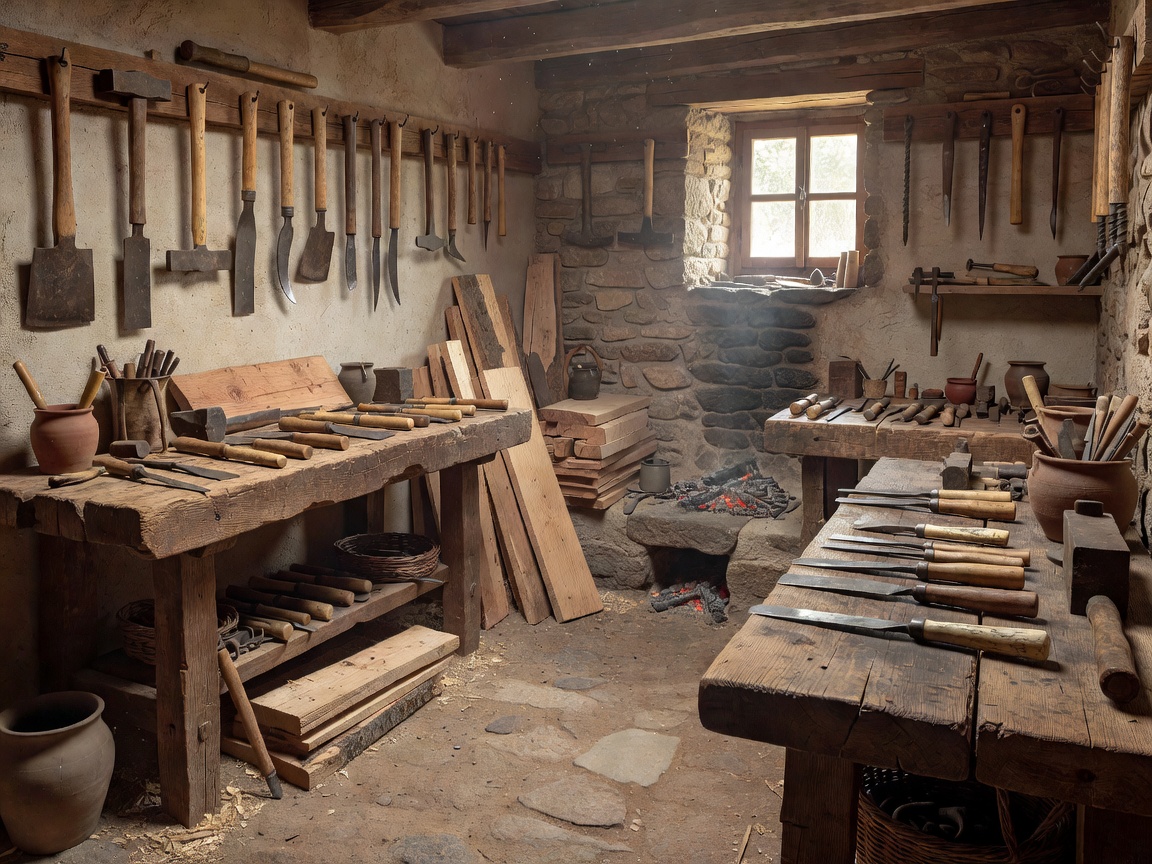
Specialist schools
Specialist schools often organise learning around a material, discipline or qualification route. A student may spend longer on drawing, material science, workshop practice and critique than in a short public workshop. Ask whether the programme is vocational, independent, assessed or simply instructional. Names and status vary by country.
Independent workshops
Independent workshops can offer close observation of a working practice. Teaching may be built around a commission, a small object or a sequence of demonstrations. The format can be direct and practical, but documentation, accessibility and cancellation terms may be less standardised. Confirm what is included before travel.
Cultural institutions
Museums, archives and cultural centres sometimes host public making sessions linked to collections or local practice. These can provide useful historical context. A public programme is not automatically a professional qualification or an endorsement of a particular interpretation. Check the stated learning outcome.
Vocational craft education
Vocational routes usually connect practical competence with broader workplace expectations. They may include production planning, safety, drawing, material knowledge and assessment. Entry requirements, duration and recognition are jurisdiction-specific. Compare official information rather than assuming that similar course names have equal status.
Community workshops
Community studios and makerspaces can lower the threshold for local practice. They may provide shared equipment, open sessions and peer learning. Their strengths are continuity and access to a network. Their limitations may include variable supervision, limited specialist tools or schedules that do not suit visitors.
Rural craft centres and urban studios
Rural settings may have closer access to forestry, fibres, clay, stone or agricultural materials, but transport and accommodation can require more planning. Urban studios may offer stronger public transport, specialist suppliers and mixed communities, with higher space pressure. These are planning factors, not fixed cultural rules.
Comparing regions responsibly
Wood traditions in the Alpine region, textile production around the Baltic and Nordic areas, ceramics across the Mediterranean, metalwork in Central Europe, and basketry across many river and agricultural landscapes all show complex movement of skills. Borders, trade, migration and industrial change shaped them. Avoid claims that a technique belongs exclusively to one present-day nation.
Good for
- Choosing between a school, studio or community format.
- Understanding whether context is historical, vocational or recreational.
- Planning travel around transport and workshop access.
What to know
- Regional labels do not guarantee a teaching method.
- Institutional status must be checked with the provider.
- This independent guide has no affiliation with named organisations.
Related guides
Compare course formats → Use the planning guide →
Researching a region?
Send a technique, location and learning goal for a focused starting point.
Contact the archive